

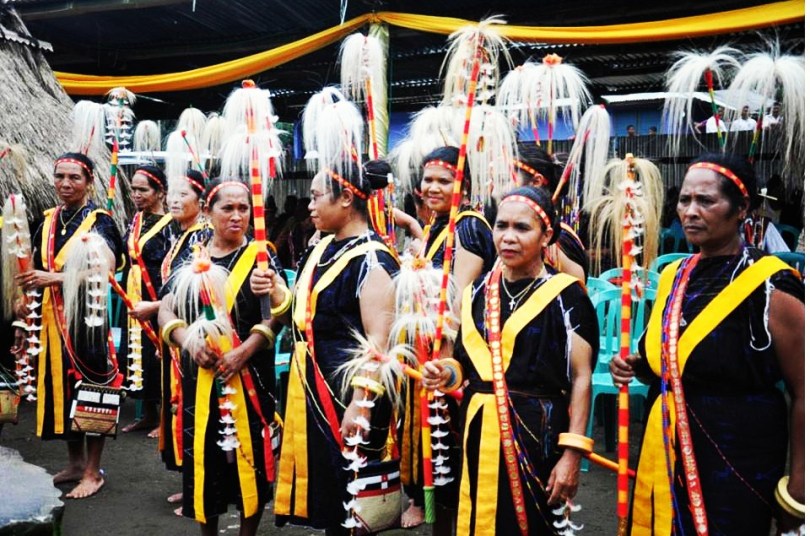
Bajawa, Vox NTT- If you come to Ngada-Flores of NTT province, calling the word “Reba” is definitely not strange to the people in that area.
Reba is a national non-objects cultural heritage which its implementation combines cultural and religious rituals.
Before the ceremony held, a day before the celebration, will be held opening ceremony Reba (su`i uwi). That night, the residents eat and drink together (ka maki Reba) while waiting for the morning. And in the morning, residents are treated with food and drink (Ngeta you bhagi ngia, mami utu mogo).
Prior to the Reba traditional ceremony, residents performed the “o uwi” ceremony. O uwi is a regional art activity in the form of dances and songs which then held mass inculturation in the church led by priest. This activity as a form of traditional custom with the Catholic religion fusion. The ceremony also presents the chorus of church chanting using the local language of Ngada.
Outside the church, ceremony participants and dancers will be treated to one or two glasses of arak (traditional wine), which local people call it with the Tua Ara. Indigenous activities Reba not just a spree party, but also a form of community joy while maintaining the spiritual nuances.
Reba ceremony is a form of gratitude of Ngada people aimed at his ancestors. Sweet potatoes become the main dish in this traditional ceremony. This is because for Ngada people, sweet potato is a source of food that will not be depleted provided by the human earth. Thus, it is expected Ngada society will never experience food insecurity.
The word Reba if it is associated with Malay language has the meaning of “noisy”, and noisy means hurricane. (Pewartanusantara.com).
“Sili Ana Wunga, da Nuka Pera Gua”. This is a piece of sacred sentence that is usually echoed in the reception of the traditional party “Reba”. If translated literally it can be interpreted “Sili as the first (read: Sulung or Eldest in English), who came and showed or laid the foundation of Ngada culture including Reba.
Reba must be done once a year in the hometown, according to each customary calendar. This traditional party is still alive and continues to be performed as a ritual that has been flowing in the blood of Ngada people. Reba is usually celebrated from late December to February coincides with the rainy and windy season.
The determination date of Reba’s it self is based on a customary calendar called Paki Sobhi (Year of comb) upon the instruction of a “Mori Kepo Wesu” (the customs holder) as authorized.
Reba is celebrated as a moment to remember and honor the ancestors. In particular, it is also become a moment of reflection on the noble value inherited by the ancestors. The noble value is like the value of unity, mutual cooperation, and work tirelessly that became the foundation of human life.
This traditional New Year Culture of Bajawa is not only as a means of unifying families, tribes and cross-village, but also able to attract domestic and foreign tourists.
Not just presenting about eating, drinking and fun, but from Reba will be many interesting things to get behind this ritual. It is like dance, traditional dress, various kinds of traditional language or pata dela in ceremony, and unique and sacred Reba ceremony stage.
Ngada people deserve to be proud of this worldwide ritual. Bajawa community pride will Reba increasingly peaked at this time, after finally he was designated as the National Non-object Cultural Heritage, from the Ministry of Education and Culture on behalf of the President of the Republic of Indonesia.
It is not without reason that Ngada must be proud. This assignment is not an easy process.
Asri Moi an archaeologist who contributes a lot to the cultural heritage Ngada tells, the struggle to get recognition from the government starting from 2015 when the field of culture is still under PKPO authorities (Authorities of Education, Culture, Youth and Sport).
Not only Reba which is proposed to the ministry for official recognition, but also other Ngada culture such as Sagi, Parawitu, Ja’i Dance, and Woven. In addition, one of the traditional ceremonies of Traditional Circumcision in Soa is almost extinct, and currently can only be found in the area of Kampung Mengeruda.
The criteria assessed is that this culture is still alive, still done by the community, has the value of wisdom and affects the lives of many people.The Ministry of Education and Culture considers various aspects before establishing the Reba as a national non-object cultural heritage.
In addition, the team from the Cultural Field Ngada also prepare support data in the form of documents, writing, visual is one of the requirements that must be met.
The completeness is then sent to the province, continued to cultural preservation hall in Bali until finally in the year 2017 is designated as National Heritage Notary in the Ministry of Education and Culture. The decree is already there and just waiting for the day of reception.
The struggle to establish Reba as the non-objects national heritage, not without a purpose. There is a great mission that if unaccomplished, will also be a threat to its authenticity and sustainability.
This great mission is the effort to save the culture of Ngada. It is a common concern that without stipulation and regulation, this local culture will be annulled and claimed by other people, regions or countries.
The struggle to preserve this ancestral heritage of Reba, will still continue to raise the level of the national heritage to Unesco as a World Cultural heritage through the ministry.
And this becomes a record that must be realized through the government with the support of all parties, especially the cultural actors of the local community.
Not only that, restoring Reba to its authenticity and pure purpose is also a shared responsibility.
At least we do not allow the modernization stream to undermine the meaning of Reba’s as it should be and it is an important heritage for the younger generation to be able to know, experience and celebrate according to Pata Dela (Ancestor’s Words) and Lese Dhe Peda Pawe (Message of Wisdom of life).
Author: Arkadius Togo
Translated by Rini Kartini/HOS